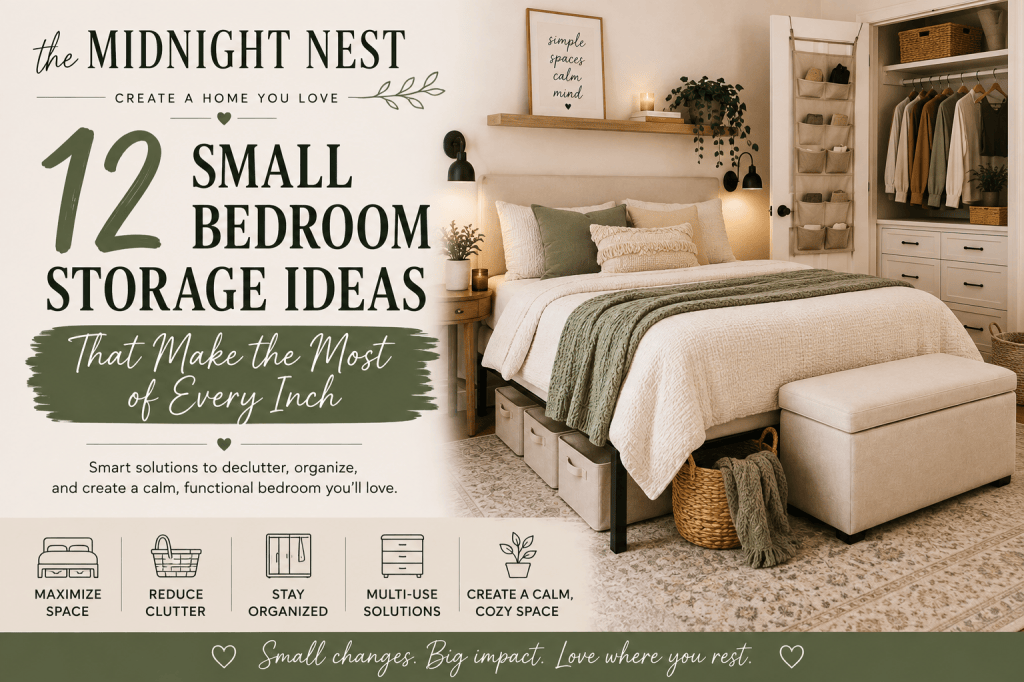
A small bedroom has to do a lot with very little square footage. It needs to hold clothing, shoes, bedding, everyday essentials, and sometimes even a workspace—while still feeling calm enough to actually sleep in.
The answer is not filling every available inch with storage bins. The best small-bedroom storage uses overlooked space, gives furniture more than one job, and makes the things you use most easy to put away. Here are twelve practical ways to create more usable storage without making the room feel even smaller.
1. Declutter Before Adding More Storage
Before ordering baskets, bins, or another piece of furniture, edit what the room is already storing. Clothes that no longer fit your life, broken accessories, excess linens, empty packaging, and items that belong elsewhere can quietly consume the limited storage you have.
Professional organizers consistently recommend removing excess before building a new system. Once you know what actually needs to stay in the bedroom, it becomes much easier to choose storage that solves a real problem instead of simply containing more clutter.
2. Put the Space Under Your Bed to Work
The footprint beneath the bed is some of the most valuable hidden storage in a small bedroom. Shallow lidded bins, rolling drawers, zippered storage bags, or a bed frame with built-in drawers can hold off-season clothing, spare linens, shoes, or less frequently used items.
Measure the available height before buying containers, and choose something you can pull out without moving half the room. If dust is a concern, covered storage is usually easier to maintain than open baskets.
3. Choose a Nightstand With Real Storage
A tiny table may look airy, but in a room short on storage, a nightstand with drawers or a cabinet can work much harder. It can hold chargers, medications, books, sleep accessories, notebooks, and all the small things that otherwise collect on top.
You can even use a small dresser as a nightstand if the proportions work. One piece doing the jobs of two is exactly the kind of trade-off that makes a compact bedroom more functional.
4. Go Up Instead of Out
When floor space is scarce, look at the walls. Tall bookcases, floating shelves, wall-mounted cabinets, hooks, and high shelves can add storage without taking another large bite out of the room’s footprint.
Keep frequently used items within comfortable reach and reserve higher shelves for things you need less often. Vertical storage works best when it feels intentional rather than when every wall is covered from floor to ceiling.
5. Free Up the Nightstand With Wall-Mounted Lighting
A table lamp can occupy a surprising amount of space on a small nightstand. A wall-mounted or plug-in sconce frees that surface for a book, water, phone, or simply some welcome empty space.
Plug-in options can offer the look of installed bedside lighting without requiring electrical work. Renters should use mounting methods permitted by their lease and follow the fixture’s installation requirements.
6. Use the Back of the Door
The back of a bedroom or closet door can hold shoes, accessories, bags, scarves, hats, or smaller clothing items with an appropriate over-the-door organizer or hook system.
This is particularly useful in rentals because many over-door systems require no permanent installation. Just make sure the organizer does not interfere with the door closing properly or exceed what the door and hardware can safely support.
7. Give the Foot of the Bed a Second Job
If there is enough walking clearance, a storage bench or trunk at the foot of the bed can hold blankets, extra pillows, seasonal items, or clothing while also providing a place to sit.
In very tight rooms, skip this idea rather than forcing it. Storage should make the bedroom easier to move through, not turn the path around the bed into an obstacle course.
8. Use Drawer Dividers for Small Categories
Dressers lose usable space when small items become one large pile. Adjustable dividers or small drawer organizers can create dedicated areas for socks, underwear, accessories, sleepwear, and other categories.
The goal is not picture-perfect folding. It is being able to see what you own and put it away without rearranging the entire drawer every time.
9. Consider a Tall Dresser Instead of a Wide One
If you are shopping for bedroom furniture, a tall dresser can provide useful drawer space with a smaller floor footprint than a long, low dresser. That can free wall and floor space for circulation, a desk, or simply a less crowded layout.
Always consider stability with tall furniture. Follow the manufacturer’s instructions for anchoring or tip-over prevention, especially in homes with children.
10. Add Hooks Where Clutter Naturally Lands
If clothing, robes, bags, or tomorrow’s outfit always end up on a chair, give those items a more deliberate landing place. A few well-positioned hooks can prevent the familiar bedroom “clothes chair” without requiring another piece of furniture.
Place storage where the behavior already happens. An organization system is much easier to maintain when putting something away takes roughly the same effort as dropping it on the floor.
11. Use Attractive Baskets for the Things That Need to Stay Accessible
Not everything needs to disappear behind a cabinet door. A good-looking basket can hold extra blankets, yoga gear, books, slippers, or other items you want nearby without leaving them scattered around the room.
Choose baskets because they solve a category problem, not because an empty shelf seems to need one. Too many containers can make a small room feel visually busier rather than calmer.
12. Make Every Piece of Furniture Earn Its Space
Small bedrooms reward furniture that does more than one thing. A storage bed, dresser used as a nightstand, ottoman with hidden storage, headboard with shelves, or compact desk with drawers can eliminate the need for additional pieces.
Before bringing anything new into the room, ask what function it adds and whether something you already own could do the same job. The fewer pieces required to meet your needs, the more breathing room the bedroom keeps.
What Should You Store Under the Bed?
Under-bed storage is best for items you need occasionally rather than several times a day: out-of-season clothing, spare bedding, extra towels, sentimental items, or shoes that are not in regular rotation. Use covered containers where practical and label anything you cannot easily see through.
How Do You Make a Small Bedroom Feel Less Cluttered?
Prioritize clear walking paths and a few visually quiet surfaces. Reduce what lives permanently on the nightstand and dresser, keep the floor as open as practical, group small items instead of scattering them, and repeat a limited palette of materials or colors in visible storage.
A small room does not have to look empty to feel restful. It simply needs enough structure that your belongings are not competing for attention everywhere you look.
5 Small-Bedroom Products Worth Considering
Affiliate disclosure: This section contains Amazon affiliate links. If you make a purchase through one of these links, The Midnight Nest may earn a commission at no additional cost to you.
Budding Joy 95L Under-Bed Storage Containers, 4 Pack
A roomy option for turning unused space beneath the bed into storage for extra bedding, seasonal clothing, sweaters, pillows, and other bulky soft goods. The clear top makes it easier to see what is inside before pulling a container out.
View the Budding Joy under-bed organizers on Amazon (paid link)
Onlyeasy Under-Bed Shoe Storage Organizer, Set of 2
If shoes are the bigger problem, this two-piece organizer is designed specifically for under-bed shoe storage, with divided compartments and a clear viewing window. The listing says the set can accommodate 12 to 24 pairs depending on shoe size.
View the Onlyeasy shoe organizers on Amazon (paid link)
Simple Houseware 24-Pocket Over-the-Door Organizer
This is a practical way to use vertical space that would otherwise go untouched. The 24 pockets can hold shoes as intended, but they can also corral accessories and other small bedroom items without adding another piece of furniture.
View the Simple Houseware door organizer on Amazon (paid link)
SONGMICS 43.3-Inch Folding Storage Ottoman Bench
For a bedroom with enough clearance at the foot of the bed, this bench combines hidden storage with a padded seat. Its flip-top design also makes the contents easier to reach than a trunk-style lid that has to be completely removed.
View the SONGMICS storage ottoman on Amazon (paid link)
Koopala Rechargeable Magnetic LED Wall Sconce
A cordless wall light can free up precious nightstand space without requiring a traditional hardwired bedside fixture. This rechargeable Koopala model offers three brightness levels and a removable magnetic light that can rotate to direct illumination where you need it.
View the Koopala wall sconce on Amazon (paid link)
Measure your space before ordering, especially for under-bed storage and the ottoman bench. The best organizer is the one that fits both the available space and the things you genuinely need to store.
Create More Room Without Creating More Clutter
Small-bedroom storage is less about finding secret square footage and more about using the room’s existing square footage intentionally. Look under the bed, up the walls, behind doors, and inside furniture before assuming you need a larger room.
If you are furnishing the room too, our affordable bed frame guide can help you find a stylish foundation. And many of the principles in our renter-friendly decorating guide work especially well in small bedrooms.
Sources & Research
This guide was informed by current 2026 small-bedroom organization guidance from Architectural Digest, Apartment Therapy, and Martha Stewart, including recommendations around under-bed storage, multipurpose furniture, vertical storage, wall-mounted lighting, and reducing excess before adding organizers.
 The Midnight Nest
Leave a comment