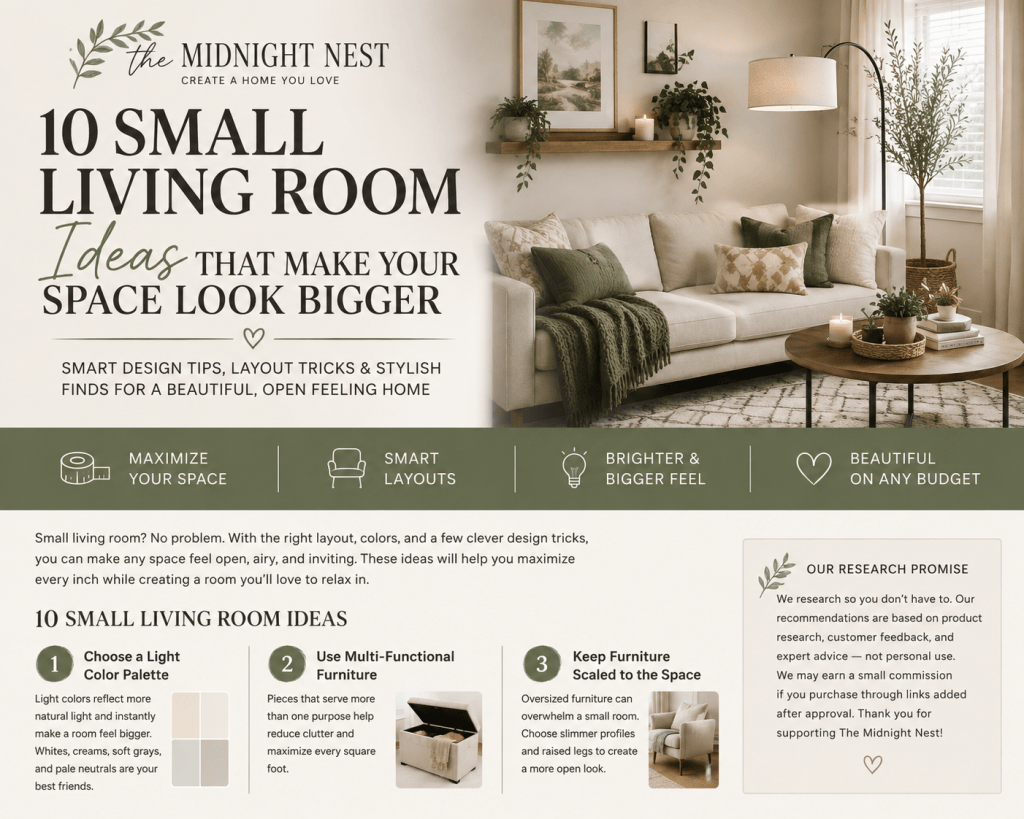
A small living room does not have to feel cramped. You may not be able to add square footage, but you can change how the room feels by paying attention to layout, visual weight, light, storage, and the scale of the furniture you bring into it. Better yet, many of the changes that make a compact room feel more open cost little or nothing.
The goal is not to make your living room look empty. It is to make the space feel intentional: clear enough to move through comfortably, cozy enough to actually live in, and organized enough that your eye is not stopping at clutter everywhere it lands. Here are ten practical ways to make a small living room look and feel bigger.
1. Start With the Walkways, Not the Furniture
Before buying anything new, look at how you physically move through the room. If you have to turn sideways around a coffee table, squeeze between a chair and the sofa, or walk an obstacle course to reach the hallway, the room is going to feel smaller than it is.
Try rearranging what you already own so the main paths through the room are obvious and unobstructed. You may discover that removing one unnecessary side table or shifting a chair a few inches does more for the space than buying a whole new set of furniture.
2. Let Some of the Floor Show
Furniture with exposed legs can make a compact room feel visually lighter because you can see underneath it. A sofa, chair, console, or side table raised off the floor allows your eye to travel farther instead of meeting a solid block of upholstery or cabinetry.
You do not need every piece to have skinny legs, but mixing heavier furniture with a few more open pieces can prevent the lower half of the room from feeling crowded.
3. Use One Properly Sized Rug Instead of a Tiny One
It is tempting to buy a small rug for a small living room, but an undersized rug can visually divide the floor into an even smaller island. When possible, choose a rug large enough to connect the main seating pieces—often with at least the front legs of the sofa and chairs resting on it.
The effect is subtle but important: instead of seeing several disconnected pieces of furniture floating around the room, your eye reads one cohesive seating area.
4. Draw the Eye Upward
When floor space is limited, use the height you already have. Hanging curtains closer to the ceiling, choosing a tall narrow bookcase, or arranging artwork vertically can emphasize the full height of the room.
This is especially useful in rooms where too many short pieces—low shelves, short curtains, little tables, and small artwork—create a horizontal line that makes the walls seem shorter than they really are.
5. Put Mirrors Where They Can Reflect Something Useful
A mirror can bounce light around a room and create a sense of depth, but placement matters. Instead of hanging one wherever there is an empty wall, look for a location where it can reflect a window, lamp, attractive view, or another bright part of the room.
One larger mirror often creates a cleaner effect than covering a small room with lots of tiny reflective pieces. You want additional light and depth—not another wall full of visual clutter.
6. Choose Furniture That Does More Than One Job
Every piece of furniture uses valuable floor space, so multifunctional pieces can be especially useful in a compact living room. A storage ottoman can hold blankets while serving as a footrest or occasional table. Nesting tables can separate when guests need them and tuck together afterward. A media console with closed storage can hide games, cords, paperwork, and everyday clutter.
This does not mean every piece needs a secret compartment. It simply means asking whether one item can solve two problems before adding two separate pieces to the room.
7. Keep the Color Palette Connected
Light colors can help a room feel airy, but you do not have to paint everything stark white. Creams, warm whites, pale taupes, soft greens, muted blues, and other gentle tones can all work beautifully in a smaller space.
More important than choosing one specific color is avoiding unnecessary visual chopping. When walls, large furniture, curtains, and rugs have some relationship to one another, the eye can move around the room more smoothly. You can still add darker or brighter colors through pillows, art, throws, plants, and other smaller accents.
8. Layer Your Lighting
One overhead light in the center of the ceiling can leave corners dark, which makes the boundaries of a small room feel more obvious. Instead, spread light around the space with a combination of ceiling lighting, floor lamps, table lamps, or wall-mounted lighting where practical.
You are not trying to make the living room as bright as a grocery store. The goal is to eliminate gloomy dead zones and create several warm pools of light that make the whole room feel usable.
9. Use Vertical Storage Before Adding More Floor Furniture
If you are running out of places to put things, your first instinct may be another cabinet, basket stand, or storage table. Before sacrificing more floor space, look at the walls.
Tall bookcases, floating shelves, wall-mounted storage, and vertical organizers can provide useful storage while preserving more of the room’s footprint. Just resist the urge to fill every inch. A little empty space around books, baskets, plants, and decor gives the eye somewhere to rest.
10. Stop Assuming Every Piece Has to Be Tiny
This is one of the easiest small-space mistakes to make. Filling a room with a tiny sofa, tiny chair, tiny table, tiny rug, and several tiny storage pieces does not automatically make it feel larger. Sometimes it simply creates more individual objects for your eye to process.
A few appropriately scaled pieces can feel calmer and more intentional than a collection of miniature furniture. Choose the sofa that comfortably seats the people who actually use the room, then be selective about what earns the remaining floor space.
What Makes a Small Living Room Feel Bigger?
The biggest difference usually comes from combining several small changes rather than relying on one decorating trick. Clear walking paths improve flow. Visible floor and furniture legs reduce visual weight. A properly sized rug unifies the seating area. Mirrors and layered lighting move brightness around the room, while vertical storage makes better use of the walls.
Most importantly, give yourself permission to own less furniture. A living room does not need every piece sold in a matching set. If you use the sofa every day but never sit in the second accent chair, the empty floor space may be more valuable than the chair.
Make the Space Work for the Way You Actually Live
A beautiful small living room is not one that successfully pretends to be enormous. It is one that feels comfortable, functional, and easy to live in despite its size. Measure before you buy, prioritize the pieces you genuinely use, and let the room breathe wherever you can.
If you are shopping for furniture for a compact room, The Midnight Nest’s 5 Best Walmart Sofas for Every Budget in 2026 and 7 Best Walmart Storage & Organization Finds for a Clutter-Free Home in 2026 are good places to continue your planning. As our site grows, we’ll keep adding practical furniture guides, affordable home finds, and realistic decorating ideas for creating a home you love—whatever its square footage.
 The Midnight Nest
Leave a comment